On 9 October, EU trade commissioner Maroš Šefčovič announced that China had agreed to cap its hybrid car exports to the EU at 350,000 a year. Beijing had previously called voluntary export restraint a serious violation of WTO rules. Something changed. The concession is real, but small, and written so both sides can declare victory.
Brussels measures 350,000 against the 800,000 Chinese hybrids expected this year and talks of halving imports. Beijing measures it against the 302,000 shipped in 2025 and calls it an “upward arrangement.” Both are right. Hybrids are a few percent of Europe’s €559 billion in annual imports from China.
Why Beijing blinked
Europe will want to push into other sectors. It already is: the Commission is reported to be screening chemicals and machinery import data.
But the aim is a quota high enough that Beijing does not retaliate — a method designed not to hurt.
Why so careful? Because Europe and China share a weakness: both live by exporting, China more so. Beijing’s model rests on suppressed consumption at home and an export machine abroad. Last year, China’s car exports rose 21% while domestic sales stalled. Chinese industry cannot sell at home what it builds.
That machine already faces one closed door. McKinsey’s 2026 global trade update finds US tariffs have cut US–China trade by about 30%, wiping out some $130 billion of Chinese exports to America. No other major economy has done anything comparable.
So when Brussels threatened a cap, Beijing judged a small concession to one market cheaper than confrontation on two — a calculation that holds only while the concession stays small and no one else gets the same idea.
Look at the drafting. Beijing’s Commerce Ministry set three conditions: no measure may target Chinese products or firms; China’s quota must be no smaller than any other supplier’s; and everything must comply with WTO rules.
Brussels obliged by casting the cap as a safeguard formally covering hybrids from every country. On paper, Europe won no concession from China; it imposed a general measure China happens to accept. Visibly yielding to one partner would invite the same request from every other.
The two readings of the number serve one purpose. “Halved” is for European industry; “upward arrangement” is for everyone else, signalling Beijing gave nothing away. The small print and the spin insure Beijing against precedent: the deal was drafted so it cannot be a template.
Europe’s lever: a letter
Šefčovič’s main instrument was a letter. Days before his trip to China, Merz and Macron asked the Commission for a new trade weapon: measures up to an “immediate cut-off” from the internal market, triggered unless a qualified majority of Member States objects. Germany, the only large country to have voted against the 2024 EV duties, has converted, removing the one state around which a blocking minority could form.
Beijing noticed the signatures too — that there were two, not twenty-seven — and what the letter is not. The instrument does not yet exist, has not even been proposed, and such tools take years to adopt. The Franco-German paper itself concedes retaliation would test European unity. The weapon depends on Germany staying converted, and the surest way to unconvert Germany is the lever China already holds.
China’s lever: rare earths
China’s leverage needs no letter. It refines around 90% of the world’s rare earths and nearly all permanent magnets for electric motors, wind turbines and guided missiles. When Beijing imposed export licensing in April 2025, European car plants stopped lines within weeks.
The most telling signal came from Germany. Before Šefčovič’s trip, German manufacturers were stockpiling rare earths in case talks collapsed. That is the kill switch seen from the other side: the country whose conversion makes Europe’s threat credible is the most exposed to China’s reply.
Paper versus ground
Can Europe remove that lever? Not soon; the question is whether it can credibly show it is on the way. Washington shares the objective of cutting strategic dependence on China, but not the means.
The Pentagon has taken a 15% stake in MP Materials, with a ten-year price floor for its magnet output, and is building a $12 billion strategic reserve for industry.
The US federal budget is around 23% of GDP, the EU’s about 1%. Short of money, the Commission designs rules to attract private capital. The Critical Raw Materials Act designates “strategic projects” and promises faster permits but, by the Commission’s own account, is not a funding instrument. The 46 projects named on 9 October need €21 billion; about €2 billion of public money has been mobilised.
In critical minerals, private capital often stays away: China sets world prices and can push them below any European project’s break-even. A French lithium venture went bankrupt in March; a Portuguese refinery could not find financing. In February the EU’s auditors said the Commission tracks implementation, not whether supply arrives.
That is the danger of governance by framework: boxes get ticked until the material is needed and is not there. Beijing is not reading the Commission’s plans; it is counting the mines.
What time is for
Finally, a quota can buy time. It cannot change the fact that a Chinese electric car costs around $20,000 to build and a European one $31,000. A gap that size finds a way in. Since September 2025, Magna Steyr’s contract plant in Graz has assembled Xpeng’s electric SUVs from Chinese kits; Chinese brands are now its lifeline. Those cars count as European and fall outside the quota.
Europe has seen this film. In 1981 Japan “voluntarily” limited car exports to the US. Detroit used the breathing space to raise prices and pay dividends; Honda, Nissan and Toyota built plants in Ohio, Tennessee and California. The restraint lasted thirteen years; the reckoning came in 2009.
Time is worth buying only if Europe spends it on two things at once: restructuring its industries, and disarming China’s strongest trade weapon by building its own supply of rare earths and critical materials — with money, not frameworks. Europe must drop its hubris and get serious. Beijing is watching to see whether it will.
Data visualisation
Sponsored content brought to you by our knowledge partner, Prismos
Europe’s child-protection debate has shifted topics.
In the first half of 2025, addictive design and teenagers’ mental health were the hot topics in the European Parliament, Commission and Council. By 2026, the talk was all about age verification: who gets an account, and how is their age checked?
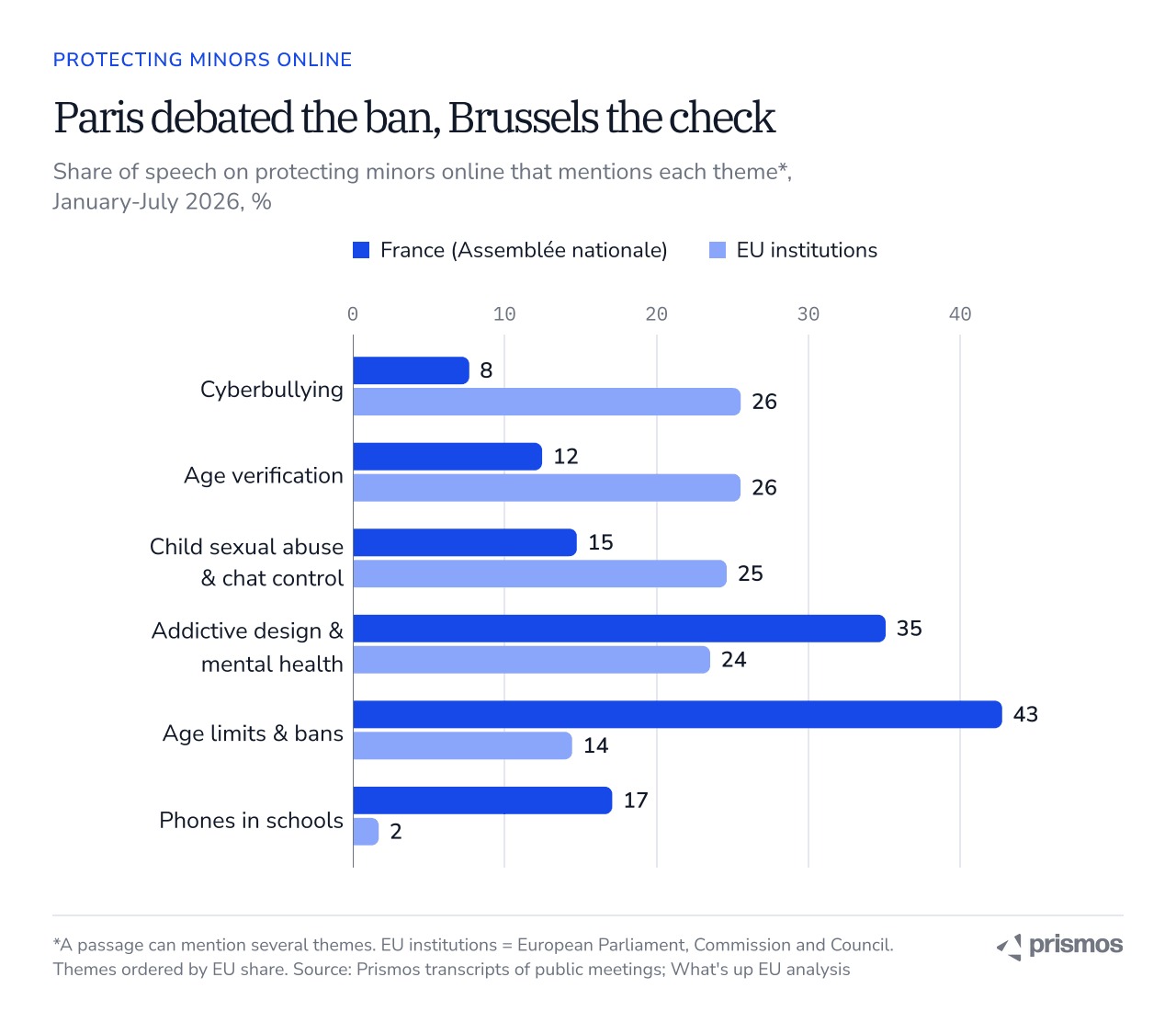
The Commission’s KIDS Act, proposed on 17 September, would ban accounts for under-13s and impose age verification at sign-up.
Paris went the other way, passing a bill banning social media for under-15s in July.
In August, the Conseil constitutionnel struck that ban down, in part because it failed to properly codify age verification checks, exactly the question the Assemblée had debated least.