This edition is brought to you by

Hello! This is Thomas writing from Paris, today is 26 October, and here is your weekly update on what matters most in the European Union.
This week’s briefing digs into the EU’s deal with China on hybrid car exports with Vjačeslavs Dombrovskis. Vjačeslavs is a senior fellow at the Centre for Economy & Business at GLOBSEC. An economist by training, Vjačeslavs served as a member of parliament and Latvia’s minister for economy and minister for education and science.
Also in this newsletter, we update you on the protests rocking Europe, US pressure on the EU over steel tariffs and digital rules, Canada’s “associate membership”, and the Council’s watered-down position on EU Inc. Don’t miss my selection of suggested good reads at the end of the newsletter.
A big thanks to Joe Pearn for his help putting this edition together. Feel free to share this newsletter with friends and colleagues, follow us on LinkedIn, and feel free to reach out at contact@whatsupeu.co
Best,
Thomas Harbor
Briefing Vjačeslavs Dombrovskis
The EU-China truce on hybrid car exports explained
On 9 October, EU trade commissioner Maroš Šefčovič announced that China had agreed to cap its hybrid car exports to the EU at 350,000 a year. Beijing had previously called voluntary export restraint a serious violation of WTO rules. Something changed. The concession is real, but small, and written so both sides can declare victory.
Brussels measures 350,000 against the 800,000 Chinese hybrids expected this year and talks of halving imports. Beijing measures it against the 302,000 shipped in 2025 and calls it an “upward arrangement.” Both are right. Hybrids are a few percent of Europe’s €559 billion in annual imports from China.
Why Beijing blinked
Europe will want to push into other sectors. It already is: the Commission is reported to be screening chemicals and machinery import data.
But the aim is a quota high enough that Beijing does not retaliate — a method designed not to hurt.
Why so careful? Because Europe and China share a weakness: both live by exporting, China more so. Beijing’s model rests on suppressed consumption at home and an export machine abroad. Last year, China’s car exports rose 21% while domestic sales stalled. Chinese industry cannot sell at home what it builds.
That machine already faces one closed door. McKinsey’s 2026 global trade update finds US tariffs have cut US–China trade by about 30%, wiping out some $130 billion of Chinese exports to America. No other major economy has done anything comparable.
So when Brussels threatened a cap, Beijing judged a small concession to one market cheaper than confrontation on two — a calculation that holds only while the concession stays small and no one else gets the same idea.
Look at the drafting. Beijing’s Commerce Ministry set three conditions: no measure may target Chinese products or firms; China’s quota must be no smaller than any other supplier’s; and everything must comply with WTO rules.
Brussels obliged by casting the cap as a safeguard formally covering hybrids from every country. On paper, Europe won no concession from China; it imposed a general measure China happens to accept. Visibly yielding to one partner would invite the same request from every other.
The two readings of the number serve one purpose. “Halved” is for European industry; “upward arrangement” is for everyone else, signalling Beijing gave nothing away. The small print and the spin insure Beijing against precedent: the deal was drafted so it cannot be a template.
Europe’s lever: a letter
Šefčovič’s main instrument was a letter. Days before his trip to China, Merz and Macron asked the Commission for a new trade weapon: measures up to an “immediate cut-off” from the internal market, triggered unless a qualified majority of Member States objects. Germany, the only large country to have voted against the 2024 EV duties, has converted, removing the one state around which a blocking minority could form.
Beijing noticed the signatures too — that there were two, not twenty-seven — and what the letter is not. The instrument does not yet exist, has not even been proposed, and such tools take years to adopt. The Franco-German paper itself concedes retaliation would test European unity. The weapon depends on Germany staying converted, and the surest way to unconvert Germany is the lever China already holds.
China’s lever: rare earths
China’s leverage needs no letter. It refines around 90% of the world’s rare earths and nearly all permanent magnets for electric motors, wind turbines and guided missiles. When Beijing imposed export licensing in April 2025, European car plants stopped lines within weeks.
The most telling signal came from Germany. Before Šefčovič’s trip, German manufacturers were stockpiling rare earths in case talks collapsed. That is the kill switch seen from the other side: the country whose conversion makes Europe’s threat credible is the most exposed to China’s reply.
Paper versus ground
Can Europe remove that lever? Not soon; the question is whether it can credibly show it is on the way. Washington shares the objective of cutting strategic dependence on China, but not the means.
The Pentagon has taken a 15% stake in MP Materials, with a ten-year price floor for its magnet output, and is building a $12 billion strategic reserve for industry.
The US federal budget is around 23% of GDP, the EU’s about 1%. Short of money, the Commission designs rules to attract private capital. The Critical Raw Materials Act designates “strategic projects” and promises faster permits but, by the Commission’s own account, is not a funding instrument. The 46 projects named on 9 October need €21 billion; about €2 billion of public money has been mobilised.
In critical minerals, private capital often stays away: China sets world prices and can push them below any European project’s break-even. A French lithium venture went bankrupt in March; a Portuguese refinery could not find financing. In February the EU’s auditors said the Commission tracks implementation, not whether supply arrives.
That is the danger of governance by framework: boxes get ticked until the material is needed and is not there. Beijing is not reading the Commission’s plans; it is counting the mines.
What time is for
Finally, a quota can buy time. It cannot change the fact that a Chinese electric car costs around $20,000 to build and a European one $31,000. A gap that size finds a way in. Since September 2025, Magna Steyr’s contract plant in Graz has assembled Xpeng’s electric SUVs from Chinese kits; Chinese brands are now its lifeline. Those cars count as European and fall outside the quota.
Europe has seen this film. In 1981 Japan “voluntarily” limited car exports to the US. Detroit used the breathing space to raise prices and pay dividends; Honda, Nissan and Toyota built plants in Ohio, Tennessee and California. The restraint lasted thirteen years; the reckoning came in 2009.
Time is worth buying only if Europe spends it on two things at once: restructuring its industries, and disarming China’s strongest trade weapon by building its own supply of rare earths and critical materials — with money, not frameworks. Europe must drop its hubris and get serious. Beijing is watching to see whether it will.
Data visualisation
Sponsored content brought to you by our knowledge partner, Prismos
Europe’s child-protection debate has shifted topics.
In the first half of 2025, addictive design and teenagers’ mental health were the hot topics in the European Parliament, Commission and Council. By 2026, the talk was all about age verification: who gets an account, and how is their age checked?
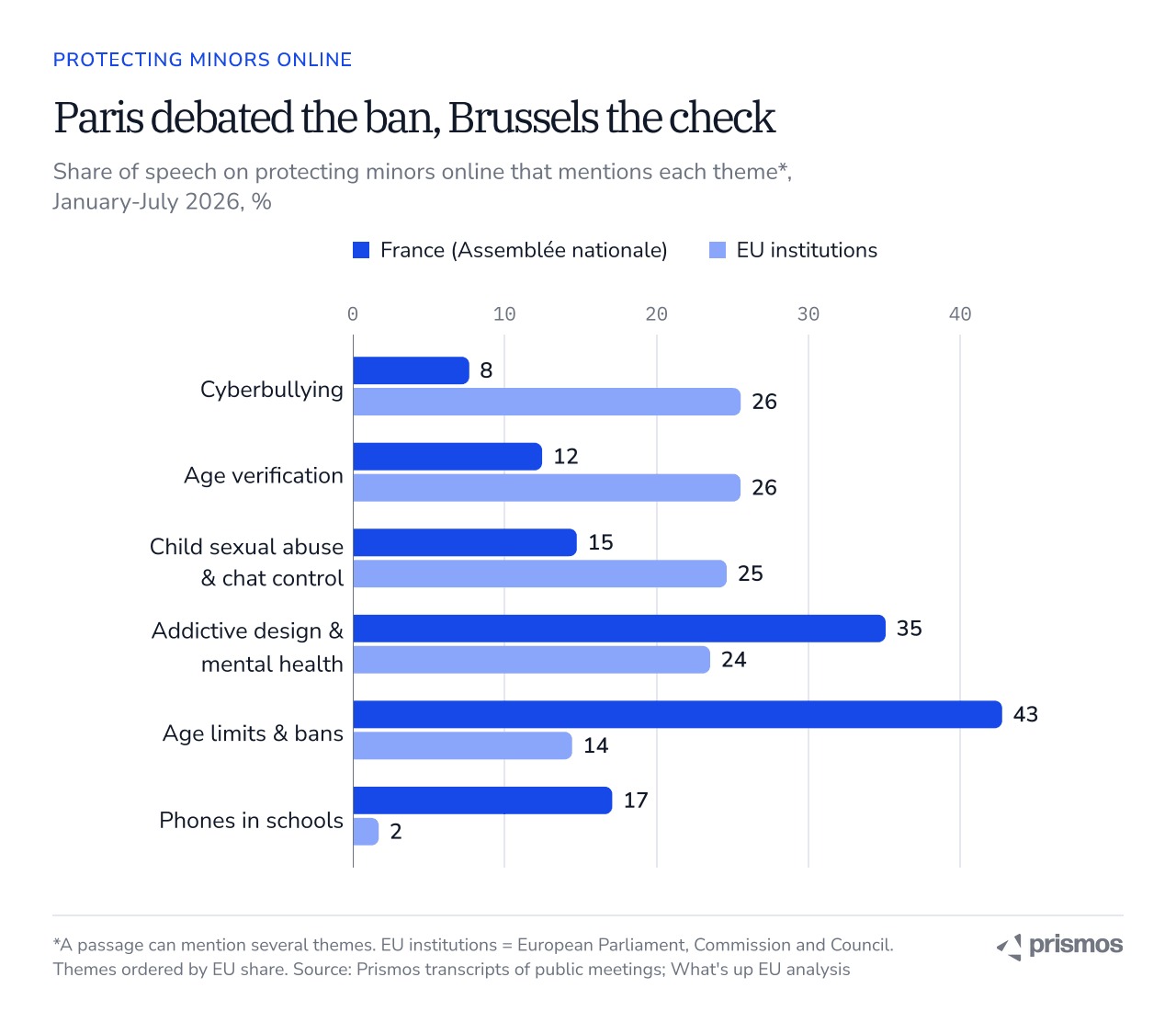
The Commission’s KIDS Act, proposed on 17 September, would ban accounts for under-13s and impose age verification at sign-up.
Paris went the other way, passing a bill banning social media for under-15s in July.
In August, the Conseil constitutionnel struck that ban down, in part because it failed to properly codify age verification checks, exactly the question the Assemblée had debated least.
Book a demo with Prismos here.
In case you missed it
RIOTS IN EUROPEProtests over living costs and school conditions have turned violent in several EU countries. The largest came in France on 17 and 18 October, with hundreds of thousands marching and at least 1,800 people arrested, while clashes also broke out in Italy and Belgium.
Bond markets reacted, with the 10-year French yield reaching its highest level since 2002 on 22 October, and Moody’s has kept its Aa3 rating and negative outlook.
Some European authorities are investigating claims of foreign interference, as pro-Russian and far-right accounts (among others) spread violent videos. The Commission says platforms must ensure their algorithms do not amplify the violence.
Intelligence officials say Russia’s role should not be overestimated and the simplest explanation for now is homegrown radicalism. The Commission would step in only if the risk became “systemic”.
US PRESSUREThe US has said it will not cut tariffs on EU steel and other goods unless the EU eases enforcement of the Digital Markets Act. The Commission has fined Apple, Meta and Google €1.59 billion under the regulation since April 2025.
The Turnberry deal struck in July 2025 capped US tariffs on most EU goods at 15%, in exchange for the EU removing duties on US industrial goods. Steel and aluminium were left out, with a 50% duty applying to EU exports to the US. The US extended those tariffs to other categories of products containing the metals in August 2025.
Under the EU regulation implementing the deal, the Commission must report by 1 December on these “derivatives” and can suspend the EU’s tariff cuts if the US still charges more than 15% on them after 31 December. There is little appetite to do so, for fear of reviving Trump’s threat to restore 25% tariffs on EU cars.
Separately, US ambassador to the EU Andrew Puzder also warned of “devastating” retaliation against European companies if the EU presses ahead with plans to reserve part of the spectrum that lets smartphones connect directly to satellites for European operators, which would limit SpaceX’s Starlink.
The Commission says the plan remains open to non-EU operators.
ASSOCIATE MEMBERSHIPSeveral Member States, including Germany and France, object to calling closer EU-Canada ties “associate membership”, diplomats say. The dispute comes as officials negotiate the joint declaration to be issued at the EU-Canada summit in Montreal on 29 and 30 October.
The objection is to the wording, not to closer ties. The countries concerned say the EU is naming the relationship before defining it. Some are annoyed that Ursula von der Leyen floated the term in her State of the Union address without consulting with governments.
According to a diplomat, the plan is to start with six priority areas, review progress after six months and take stock a year later, when Canada could become the first associate member if it meets set criteria. The Commission says it will work on acceptable language.
EU INCThe Council of the EU (i.e. the governments) adopted its position on 23 October on EU Inc, the optional EU-wide company status that the Commission proposed as a regulation on 18 March 2026.
The headline promise survives: online registration within two days, for at most €100. But governments dropped two features: a single EU company register and a simplified insolvency regime for start-ups.
As a result, each EU Inc would sit on its national register, and failed start-ups would still be wound up under national rules. Tax deferral on stock options, which spares employees from paying tax before they cash in, now applies only to firms with up to 750 staff and €150 million in turnover, thresholds that fast-growing start-ups quickly outgrow.
The EU-INC start-up campaign had already warned on 15 October that the version leaders championed “no longer exists”, and Enrico Letta said “a watered-down proposal would send the wrong signal”.
The text now goes to talks with the European Parliament, where MEPs have yet to agree a position amid disputes over worker co-determination, with a deal targeted by the end of 2026.
What Thomas Has Been Reading
- The Centre for Strategic & International Studies’s podcast held a conversation between Ilaria Mazzocco and Tobias Gehrke: “Are Europe and China on an Economic Collision Course?”. The discussion centres around whether Europe can protect its industrial base without triggering a broader trade confrontation, and what a tougher European stance on China means for transatlantic economic cooperation.
- The Economist looks at Europe’s dependence on America in space, calling it “hard to escape”. In three key areas — satellite-internet services, space-based intelligence/surveillance/reconnaissance, and launch capacity — the EU has a lot of catching up to do.