The Democratic victory in the 3 November US midterm elections delivered a major setback to Donald Trump. Having regained both chambers of Congress, Democrats will enter January with substantial powers to constrain the administration during its final two years. For European capitals and Kyiv, the result offers grounds for relief. But expectations of a fundamental recalibration of US foreign policy may be premature.
Foreign policy rarely dominates US midterm elections, but its domestic consequences helped shape this result. Trump himself acknowledged that the highly unpopular Iran war and its knock-on effects on fuel prices contributed to his party’s defeat. Yet he also insisted that he would make the same decision again. That response offers an early indication of the limits of the electoral rebuke and of the President’s defiant attitude going into the last stretch of his mandate.
Three factors should temper European expectations.
First, a constrained president is not necessarily a more accommodating one.
Trump’s instinct when challenged is to fight back. With his domestic legislative agenda facing greater resistance, he could devote more attention to foreign policy, where the presidency retains considerable unilateral influence. The pursuit of a diplomatic breakthrough, or of further confrontation abroad with the resumption of US “defensive” air strikes on Iran, could become more attractive as opportunities for legislative victories diminish.
Congress will nevertheless provide a stronger check. Democratic control brings leadership of the appropriations, armed services and foreign affairs committees, alongside greater capacity to investigate administration decisions and attach conditions to spending. In the Senate, Democrats will also have leverage over appointments requiring confirmation.
These are meaningful instruments, but they do not transfer the conduct of foreign policy to Capitol Hill. Trump had vowed to become “Mr Veto” if Democrats took control of Congress. And overriding a presidential veto requires two-thirds majorities in both chambers, making Republican support indispensable. Compounding this difficulty, Trump has a history of pointedly ignoring lawmakers.
Ukraine illustrates the risk. There is a very real prospect that the President will want to cement his legacy by seeking to end the war in Ukraine, likely on terms unfavourable to Ukraine. A telling sign is Trump’s decision to engage only with Russian envoy Kirill Dmitriev, despite both Kyiv and Moscow sending delegations to the White House to meet with the First Lady on 5 November.
The same caution applies to transatlantic trade. Despite judicial limits on some of his tariff measures, Trump retains substantial powers delegated by Congress to impose duties, notably on national security and unfair trading grounds. A Democratic majority will not automatically remove those powers or reverse existing tariffs. Europe should therefore expect continued commercial pressure from the White House.
Second, Democratic control does not guarantee a united opposition on foreign policy.
Broadly speaking, the party spans centrists more attached to traditional US global leadership and progressives more sceptical of military engagement and more focused on domestic spending priorities. These camps are not monolithic, but their differences could complicate a common approach to Ukraine.
The progressives’ October 2022 letter urging direct diplomacy with Russia, withdrawn after a backlash, illustrates these tensions. Its signatories supported continued assistance to Ukraine, but called for a stronger diplomatic push to end the war, exposing differences over how military support and negotiations should fit together. Ukrainian foreign affairs committee chair Oleksandr Merezhko has described progressives as “not too warm to Ukraine”. This certainly does not amount to endorsing Trump’s terms, but it demonstrates that influential progressive voices place greater emphasis on seeking a negotiated end to the conflict.
The more immediate question is whether support for Ukraine will translate into fresh financial help. Former Ukrainian ambassador to Washington Oleh Shamshur has cautioned that Democratic gains do not automatically mean renewed US aid. He points to pressure from parts of the progressive wing to prioritise domestic programmes—a debate currently focused heavily on Israel, but which could also affect Ukraine.
For now, Ukraine will have to continue relying primarily on the EU for assistance. By August 2026, EU institutions and Member States had allocated approximately €201 billion in aid since the invasion, compared with €115 billion from the United States.
Third, the staffing shake-up in the wake of the midterm defeat signals a possible shift further to the extremes of the MAGA agenda.
Trump’s decision to replace Susie Wiles with Stephen Miller as White House chief of staff elevates one of his most loyal and ideologically uncompromising advisers. It is reasonable to read the appointment as a sign that the administration intends to confront its opponents more aggressively, including through executive action.
Miller’s outlook also has direct implications for Europe. In January earlier this year, Miller went on broadcaster CNN and claimed that the US had the right to seize Greenland, and repeatedly declined to rule out force. His willingness to apply coercive reasoning to the territory of a NATO ally offers little reassurance about his commitment to transatlantic solidarity.
Conversely, reports that Secretary of State Marco Rubio might leave the administration - which he has since publicly denied - are troubling. While Rubio has loyally defended Trump’s policies, he remains a link to the Republican Party’s more traditional, internationalist wing and is seen by allies as a more diplomatic interlocutor. His departure, coupled with Miller’s elevation, could further marginalise that outlook within the administration, leaving Europe and Ukraine facing an even more transactional and radical White House.
The midterms give Ukraine and Europe stronger interlocutors on Capitol Hill and more opportunities to resist damaging decisions. But a change in congressional control does not amount to a change in presidential worldview. Planning on a more accommodating or predictable White House amounts to an expensive gamble.
Data visualisation
Sponsored content brought to you by our knowledge partner, Prismos
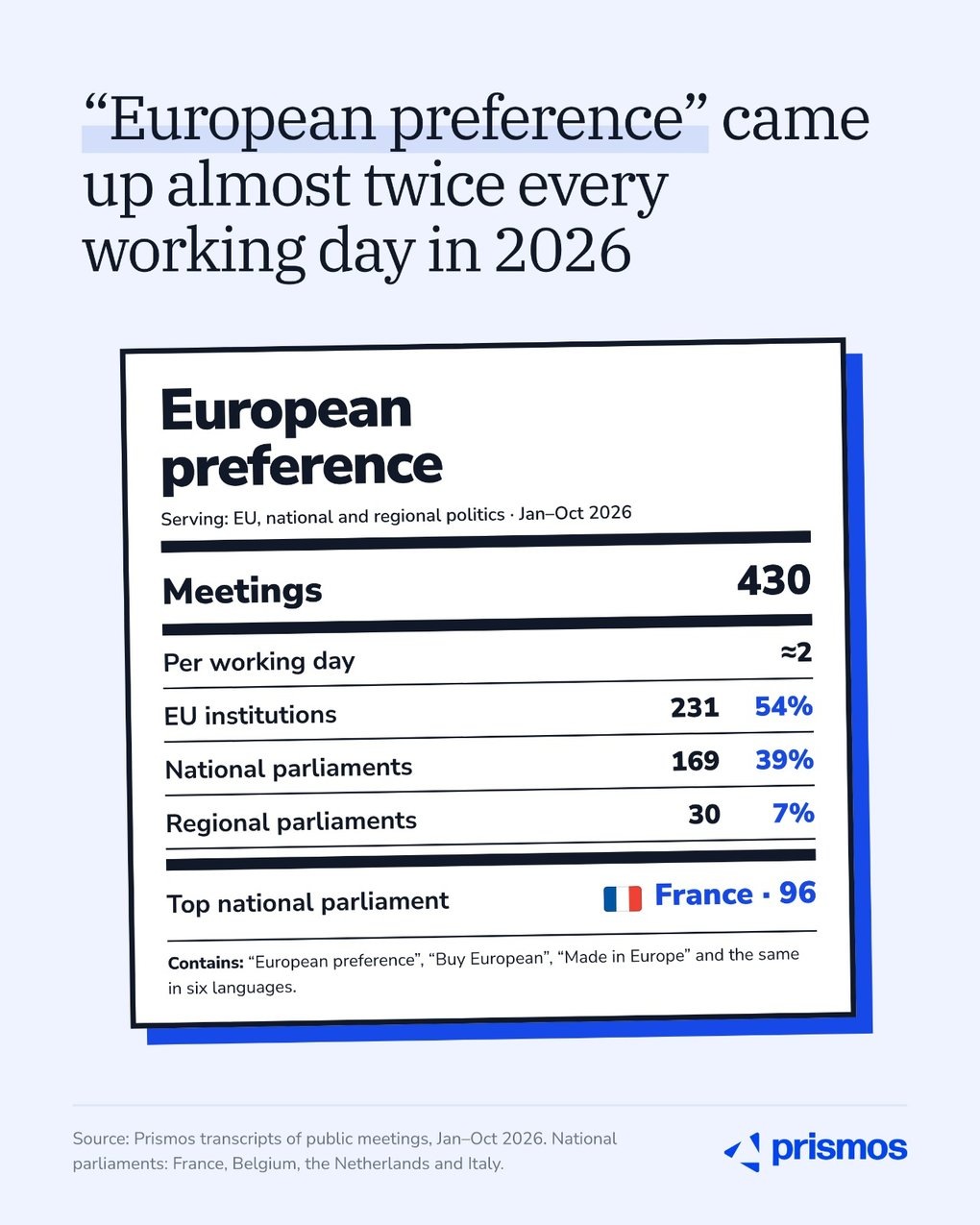
It’s the talk of the town. Throughout 2026, European preference has become a regular talking point.
Using Prismos, we analyzed the transcripts of every public debate in EU institutions (Parliament, the Commission and the Council) and in national and regional parliaments.
- The topic came up almost twice every working day, from Brussels to The Hague, or Rome.
Paris is where European preference was discussed most: in September and October alone, French MPs raised it more than the Dutch, Italian and Belgian parliaments combined.
On October 14, Benjamin Haddad, France’s minister for Europe, put it first among France’s conditions for the next EU budget, before farm funding, defence spending or new European revenues.
As talks on the EU’s 2028–2034 budget heat up, expect “Buy European” to move from speeches to the negotiating table, with Paris pushing hardest.